
Saving for your future is one of the smartest financial moves you can make. But did you know the UK government is willing to give you a significant helping hand? Through pension tax relief, you get a bonus added to your pension pot every time you contribute.
Understanding how to claim tax relief on your private pension payments is crucial to maximizing your retirement savings. The rules can differ based on your pension scheme and your income tax band. This guide will walk you through the process, including the latest thresholds, so you can ensure you’re not missing out on money that’s rightfully yours.
How Does Pension Tax Relief Work?
In simple terms, pension tax relief is a government incentive to encourage people to save for retirement. For every pound you contribute to your pension, the government adds back the tax you paid on that income. This effectively reduces the cost of your contribution.
The amount of relief you get depends on your income tax rate. The current tax bands for England and Wales (2024/25) are:
- Basic rate (20%): £1 to £37,700
- Higher rate (40%): £37,701 to £125,140
- Additional rate (45%): Over £125,140
(Note: Scotland has different income tax bands, which you can check on the GOV.UK website.)
Key Annual Allowances
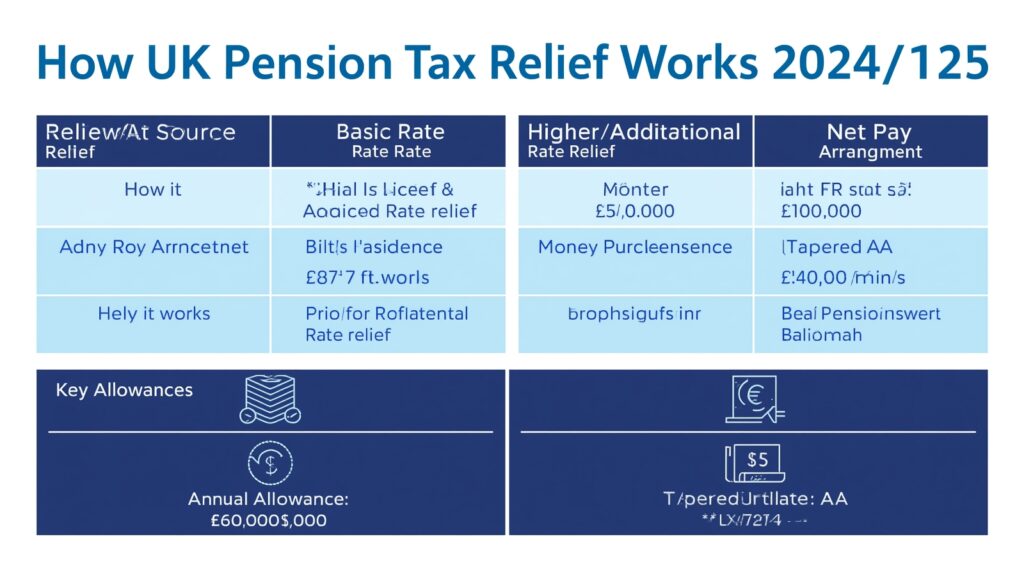
| Allowance | Limit | Applies To |
|---|---|---|
| Annual Allowance | £60,000 | Most individuals |
| Money Purchase AA (MPAA) | £10,000 | Those who have flexibly accessed a pension |
| Tapered AA (Minimum) | £10,000 | Very high earners (Adjusted Income > £260,000) |
The Two Main Methods of Getting Tax Relief
How you receive your tax relief depends on whether your pension scheme is “relief at source” or a “net pay” arrangement.
1. Relief at Source (The Most Common Method for Private Pensions)
This is the standard method for personal pensions, including SIPPs, and many workplace pensions.
- How it works: You pay pension contributions from your bank account after you’ve been paid your salary and tax has been deducted.
- The Automatic Boost: Your pension provider claims a 20% basic rate tax relief from the government and adds it to your pension pot. So, for every £80 you pay in, the government adds £20, making your total contribution £100.
- Claiming Higher Rate Relief: If you’re a higher or additional rate taxpayer, you are eligible for further relief. The automatic 20% only covers the basic rate. You must actively claim the extra 20% or 25% back.
Example: You’re a higher-rate taxpayer and pay £80 into your pension. Your provider adds £20, making it £100. You can then claim another £20 back via your tax return, reducing the real cost of your £100 pension contribution to just £60.
2. Net Pay Arrangement (Common for Workplace Pensions)
This method is often used by occupational workplace pension schemes.
- How it works: Your pension contributions are taken from your salary before your tax is calculated.
- The Automatic Benefit: Because your contributions are deducted from your pre-tax pay, you get immediate tax relief at your highest rate. There is nothing more you need to do—the system automatically accounts for it.
New Rules & Key Limits to Know (2024/25 Tax Year)
It’s vital to be aware of the pension allowances, as these have recently changed.
- Annual Allowance: This is the total amount that can be paid into your pensions each tax year without triggering a tax charge. For the 2024/25 tax year, the standard annual allowance is £60,000. This includes contributions from you, your employer, and any tax relief.
- Money Purchase Annual Allowance (MPAA): If you have started flexibly accessing your pension pot (e.g., taking a flexible drawdown), the amount you can contribute while still receiving tax relief drops significantly. The MPAA is £10,000 for the 2024/25 tax year.
- Tapered Annual Allowance: For very high earners (with a ‘Threshold Income’ over £200,000 and an ‘Adjusted Income’ over £260,000), your £60,000 annual allowance may be reduced. It can be tapered down to a minimum of £10,000.
For a full breakdown of these complex thresholds, always refer to the official HMRC Pensions Tax Manual.
How to Claim Your Missing Tax Relief
If you are a higher or additional rate taxpayer in a “relief at source” scheme, you need to claim the extra money back. You have two main options:
- Via Self-Assessment Tax Return: This is the most comprehensive method. You declare your pension contributions on your tax return, and HMRC will calculate the relief you are owed, either through a tax rebate or by adjusting your tax code.
- By Contacting HMRC Directly: If you don’t complete a tax return, you can call or write to HMRC to inform them of your pension contributions. They will then adjust your tax code for the following year, giving you the relief through a higher take-home pay.
For step-by-step guidance, the official Claim tax relief on your private pension payments guide on GOV.UK is the definitive source.
Frequently Asked Questions (FAQ)
Q: What if I’m a non-taxpayer?
A: If you don’t pay income tax, you can still pay up to £2,880 per year into a pension. Your pension provider will still add 20% tax relief, boosting your contribution to £3,600.
Q: Is there a limit to how much I can contribute?
A: Yes, you cannot contribute more than 100% of your UK relevant earnings in a tax year to receive tax relief. The Annual Allowance of £60,000 is the total limit for all contributions paid into your pensions.
Q: How do I know which type of pension scheme I have?
A: Check your pension scheme’s documentation or contact your pension provider directly. They will be able to confirm if it’s a “relief at source” or “net pay” arrangement.
Start Claiming What You’re Owed
Pension tax relief is a powerful incentive that can dramatically accelerate the growth of your retirement fund. Don’t leave free government money on the table. Review your pension contributions today, understand your scheme type, and if you’re a higher earner, take the simple steps to claim the extra tax relief you deserve.
Disclaimer: This article provides a general guide and does not constitute financial or tax advice. The rules relating to pensions and taxation are complex and may change. It is always recommended to seek advice from a qualified financial adviser or consult the official GOV.UK website for the most up-to-date information.