
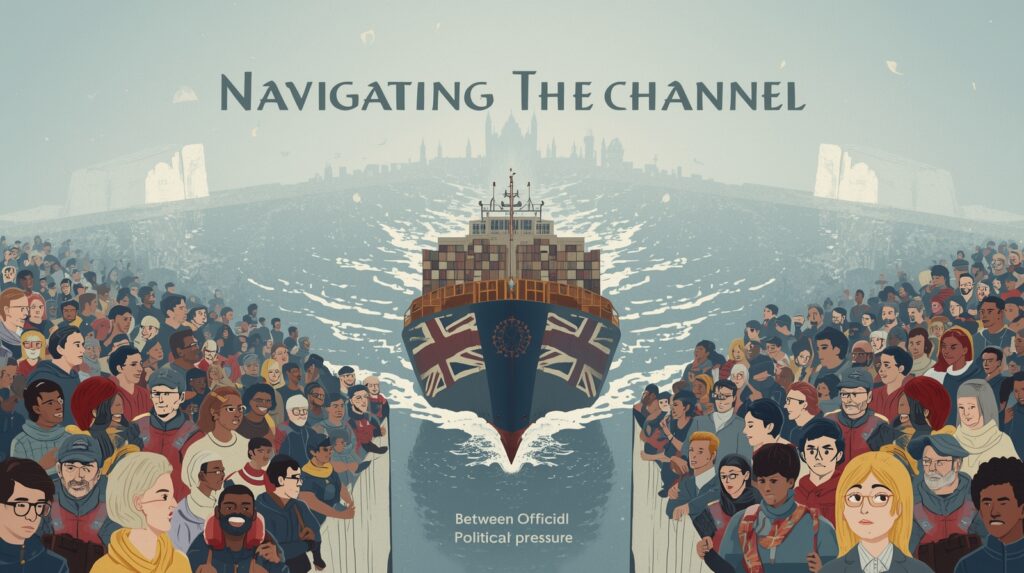
If you follow UK news, you’ve likely heard two phrases constantly repeated: the government’s pledge to “Stop the Boats” and the political challenge posed by Reform UK. While these may seem like separate issues, they are deeply intertwined. The official policies you read on GOV.UK don’t exist in a vacuum; they are forged in the fires of political competition.
This blog post will dissect the UK’s current immigration strategy, not just by looking at the official documents, but by understanding the powerful political pressures—specifically from Reform UK—that are shaping its direction and implementation. We’ll move beyond the headlines to see how government action and political reaction are two sides of the same coin.
The Foundation: The Official GOV.UK Immigration Strategy
The UK government’s immigration policy is built on two main pillars: addressing illegal migration and managing legal migration. The tone is one of control and order.
1. Tackling Illegal Migration: The Rwanda Partnership and the Illegal Migration Act
The centerpiece of the government’s approach to illegal migration is the Rwanda Partnership. As stated in the official GOV.UK policy paper, the policy aims to “deter dangerous and illegal journeys” by relocating asylum seekers to Rwanda for processing and potential resettlement. The government argues this will break the business model of people-smuggling gangs.
This policy is underpinned by the Illegal Migration Act 2023. The Act, summarized on GOV.UK, gives the government a legal duty to remove those who enter the UK illegally, regardless of their country of origin. The intended message is clear: if you arrive by illegal means, you will not be allowed to stay.
2. Managing Legal Migration: Reducing the Numbers
After years of rising figures, the government has shifted its focus to reducing legal migration. Key measures, announced in late 2023 and detailed in a Home Office news story, include:
- Raising the Skilled Worker visa salary threshold from £26,200 to £38,700.
- Restricting the ability of care workers to bring dependents.
- Reforming the Shortage Occupation List to reduce the number of roles where visas are granted below the standard salary threshold.
The objective, as repeatedly stated, is to ensure migration benefits the UK economy without placing “undue pressure on public services.”
This is the official picture: a multi-pronged, legislatively backed strategy focused on control. But to understand why this strategy has become so central and why it pursues such a hardline path, we must look at the political landscape.
The Counterpoint: Reform UK’s Immigration Stance
While the government talks of control and reduction, Reform UK advocates for a paradigm of near-total cessation. Their policy is not one of management but of confrontation. According to their official website, their key pledges include:
- Freeze Non-Essential Immigration: An immediate pause on all non-essential, low-skilled immigration.
- Leave the European Convention on Human Rights (ECHR): A fundamental step, they argue, is necessary to regain full national sovereignty over borders.
- Stop the Boats entirely: through a policy of “pick up and take back,” returning boats to France, and detaining all arrivals for processing offshore.
Reform UK frames the government’s efforts as insufficient and compromised. They argue that tinkering with salary thresholds is meaningless while illegal crossings continue and that the UK’s membership of the ECHR inherently prevents the decisive action required.
This is not merely a disagreement on policy details; it is a fundamental clash of philosophy and scale. And it is this clash that creates the intense political pressure the government operates under.
The Pressure Point: How Reform UK Shapes the Immigration Debate
Reform UK’s influence is not measured by seats in Parliament but by its power to shift the political “Overton Window”—the range of policies considered acceptable—and to directly threaten the electoral prospects of the governing Conservative Party.
1. The Electoral Threat and the Shift to the Right
Polls consistently show that voters who consider immigration a top priority are increasingly likely to support Reform UK. This creates a direct incentive for the Conservative government to adopt a tougher rhetoric and more radical policies to win them back. The government’s entire “Stop the Boats” slogan is, in part, a direct response to this threat. It is a simple, powerful message designed to resonate with voters who feel the system is out of control.
The focus on the Rwanda policy is the clearest example. While the policy was conceived before Reform’s current surge, its dogged pursuit despite legal challenges and immense cost is a political necessity for the government. Abandoning it would be seen as an admission of defeat and would likely trigger a significant defection of voters to Reform. It has become a symbolic “red line.”
2. The ECHR as a Political Battleground
Reform UK’s pledge to leave the ECHR has forced the government to constantly defend its position. While the current government has stopped short of advocating withdrawal, the ECHR is now a central feature of the immigration debate. Ministers frequently criticize the Court, and the Illegal Migration Act was specifically designed to test its limits.
This pressure creates a dynamic where the government must appear to be fighting the ECHR, even while working within its framework. The threat of leaving, once a fringe idea, is now a mainstream topic of discussion, thanks largely to Reform’s advocacy. For more on the legal complexities of this, see this informative explainer from the Institute for Government.
3. Setting the Terms of the Debate on Legal Migration
The government’s recent crackdown on legal migration, particularly the sharp increase in the skilled worker salary threshold, can also be seen as a reaction to the broader narrative. Reform UK successfully frames all immigration through a lens of strain and burden. By focusing on reducing the headline numbers, the government is attempting to demonstrate that it is listening to these concerns and taking decisive action, even if it faces criticism from business groups worried about labour shortages from the BBC.
Analysis: A Strategy Constrained by Politics
So, what does this mean for the overall UK immigration strategy?
The government finds itself in a difficult position. Its policy, as outlined on GOV.UK, is pulled in two directions:
- On one side, it faces practical and legal realities: international law, diplomatic relations with France, Supreme Court rulings, and the needs of the UK economy for specific workers.
- On the other side, it faces intense political pressure from Reform UK, which advocates for solutions that are often in direct conflict with those realities.
The result is a policy that can appear caught in a cycle of announcement and reaction. Each new policy is measured not just by its practical effect but by its potency as a political message to a specific segment of the electorate. The Rwanda policy is less notable for its operational impact (as, to date, no flights have taken off) than for its role as a symbolic commitment to a hardline approach.
Conclusion: A Battle for the Soul of UK Border Control
The UK’s immigration policy is more than the sum of its laws and official announcements on GOV.UK. It is a live arena where the official strategy of the state is continuously shaped and pressured by a potent political rival.
Understanding the policy requires reading the GOV.UK documents, but truly understanding its direction and intensity requires listening to the arguments from parties like Reform UK. They have successfully placed immigration at the very center of political discourse and have shifted the consensus significantly towards reduction and control.
The critical question for the future is whether the government’s current path—a legally complex, high-cost pursuit of a deterrent through Rwanda, combined with restrictions on legal routes—can actually succeed in its stated goals. Will it “stop the boats” and reduce net migration to the promised tens of thousands? Or will the gap between political promise and operational reality continue to be the space where alternative voices like Reform UK thrive?
The battle for the UK’s borders is being fought not only in the English Channel but also in the battle of ideas and electoral politics. And the outcome will define the nation’s identity for years to come.
Want to understand how this dynamic plays out in other policy areas? Read our next post, The Price of Green: Analyzing the UK’s Evolving Net Zero Strategy, where we break down the official climate targets and the political pressures causing them to change.